


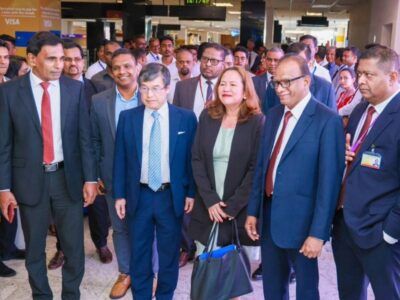
Sri Lanka is strengthening its border systems and improving passenger convenience as it takes a major step towards becoming a modern aviation hub. The country recently launched its first Automated Border Control (ABC) e-gates at Bandaranaike International Airport, marking a significant milestone in safer, smarter border management.
The initiative was launched on 28 January 2026 by the Ministry of Ports and Civil Aviation, in partnership with the Embassy of Japan and the International Organization for Migration (IOM). The introduction of ABC e-gates forms part of a Japan-funded project implemented by IOM to strengthen Sri Lanka’s border control capacity, particularly in responding to infectious diseases and enhancing health security across Southwest Asia.
Speaking on the occasion, Hon. Anura Karunathilaka, Minister of Ports and Civil Aviation, reaffirmed Sri Lanka’s commitment to advancing its aviation and port sectors through modernization guided by global standards in safety, health, and sustainability. He noted that these strategic efforts reinforce Sri Lanka’s role as a secure and efficient gateway for international travel and trade, while supporting broader economic recovery and long-term development.
With a total project value of USD 8.4 million, the initiative reflects Japan’s strong commitment to regional pandemic preparedness, health security, and safe mobility. It aligns closely with Sri Lanka’s national priorities for digital transformation, public health security, and compliance with the International Health Regulations (IHR), while also strengthening emergency preparedness and resilience.
Japanese Ambassador Isomata highlighted that the project goes beyond immediate health and border security benefits, emphasizing the importance of preparedness and resilient borders not only during pandemics, but also in the context of disasters. Recent severe cyclones have underscored the need for robust systems that manage the movement of people and goods while mitigating public health risks.
Tourism, as a critically important sector for Sri Lanka’s economic recovery, stands to benefit significantly from these enhancements. Alongside the IOM-implemented project, Japan’s yen-loan assistance is supporting the expansion of Bandaranaike International Airport, with the construction of a new terminal as its main component. Upon completion, this expansion is expected to transform the main international gateway to Sri Lanka, delivering long-term benefits for travellers and the wider economy.
As part of the project, and with continued support from the Government of Japan, IOM has handed over a range of advanced border management and health-security equipment. These include cutting-edge screening systems, biometric access controls, and upgraded facilities designed to enhance border security while improving the overall passenger experience.
Passengers will soon experience faster immigration clearance through the new e-gates, reducing waiting times and improving airport efficiency. This milestone reflects Sri Lanka’s progress in digital transformation and reinforces its role as a safe, connected, and future-ready mobility gateway in South Asia.

 Read more
 Read more
 Read more
 Read more
 Read more
 Read more
 Read more
 Read more
 Read more
 Read more